
Feral Beauty and Learning to See the Whole Landscape

This morning, seven deer grazing peacefully across our middle paddocks. Among them were a few young fawns, their spotted coats still visible as they bounded and gamboled through the lush winter grass while their parents kept a watchful eye. They stayed for hours, bathed in the soft morning light. It was impossible not to feel a quiet sense of wonder. Deer carry a timeless, almost mystical aura, steeped in folklore and myth across the European cultures as symbols of grace, gentle strength, and the spirit of the forest. Sitting there, watching them, you feel like you are standing in the presence of something sacred and majestic.
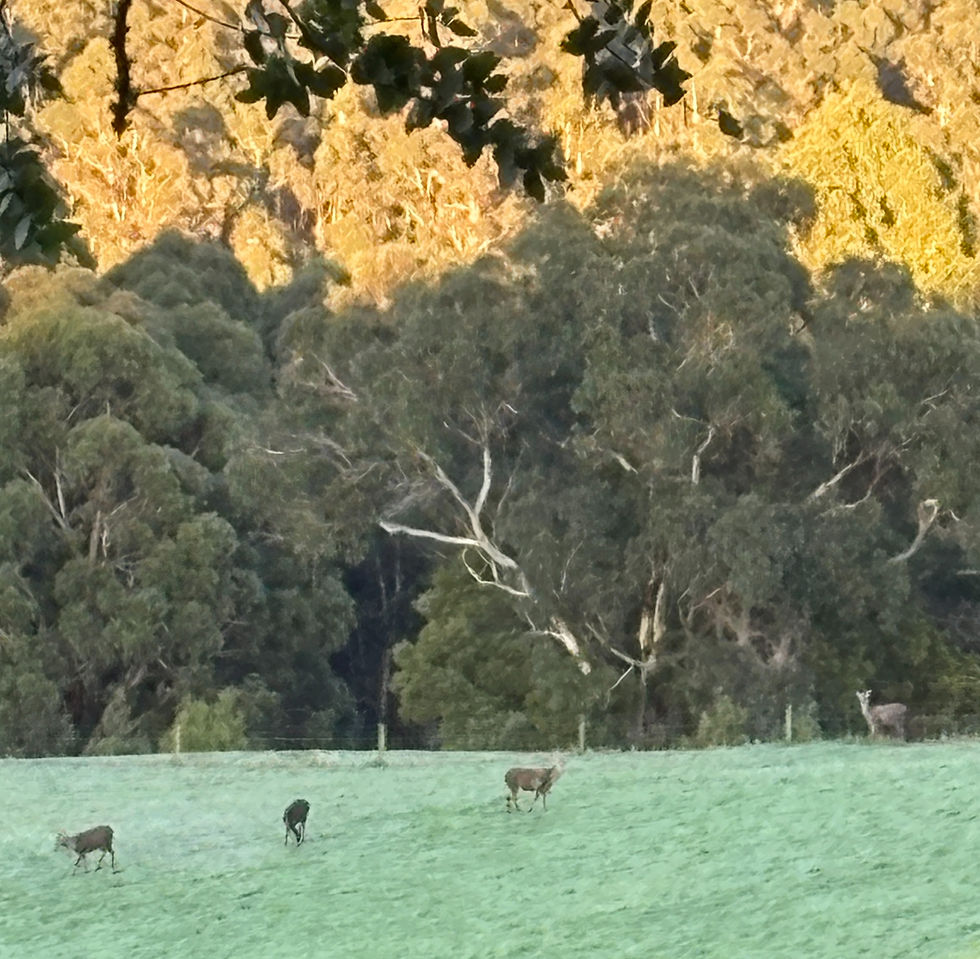
And yet, as someone working to tend and restore this land, that sense of awe is tempered by an uncomfortable truth. Here in Australia, deer are not part of the ancient story of the land. They are introduced, and their presence comes at a steep ecological cost. Their hard hooves compact the soil, they ring-bark young saplings, and they strip back the delicate native understory that our indigenous wildlife relies on for shelter and survival. Left unchecked, their appetite outpaces the land's capacity to heal.
Even where deer are native, the delicate balance has fractured. I’ve recently been reading Our Oaken Bones, which paints a vivid picture of a farm in England where deer have belonged for millennia. Yet even there, without natural apex predators like the wolf, their populations have exploded. They devour the acorns and graze down the fragile oak saplings, effectively halting the forest's ability to regenerate. The author, Merlin, occasionally and ethically culls the deer himself—providing high-quality, wild-harvested meat that feeds his family and local community for months.
It made me reflect on a card we found tucked into our gate a few weeks ago: an offer from a licensed deer harvester to manage the population on our property. My initial, knee-jerk reaction was a sharp pang of shock. Culling feels violent, especially when you’ve just been admiring a fawn at play.
Yet, as the shock settled, a vivid memory resurfaced from my childhood. Growing up on a farm, my father used to take me out deer spotting. When I was about eight years old—before my father had a son, he shot a deer while we were out at camp. We brought it home, hung it in the shed, and he showed me how to butcher it. It was a rite of passage, an initiation into the raw realities of farm life, nature, and where our food truly comes from. I still carry that as a core childhood memory, not of violence, but of deep respect, connection, and understanding about the cycle of life. We ate that venison for months; Dad’s specialty was a savoury minced venison rolled into red wine pancakes.
Whole Landscapes & Living Mindfully
Today, I live as a vegetarian, guided by a desire to tread lightly on this earth. But as I look at our current world, facing soaring food costs, climate instability, and the environmental toll of industrial agriculture, I find my perspective shifting into something more complex.
It begs an uncomfortable question: Why do we continue to clear land and industrialise cattle and sheep farming, practices that so often deplete topsoil, pollute waterways, and degrade ecosystems, while turning our backs on wild, overpopulated animals that are actively disrupting local ecology? In the absence of natural predators, these populations need management. Integrating wild, ethically harvested game into local food networks seems far more aligned with genuine land stewardship than intensive animal agriculture.
This cultural shift toward eating invasive species was brilliantly brought to light by artist and curator Kirsha Kaechele through her groundbreaking project Eat the Problem. Rooted in the idea of transforming ecological destruction into culinary art, her work culminated in the documentary series Eat The Invaders. Hosted alongside Tony Armstrong and featuring chefs from Tasmania’s Museum of Old and New Art (MONA), the series explores how animals overrunning Australian ecosystems, such as feral deer, carp, rabbits, and cane toads, could be ethically harvested and reframed as a sustainable protein source. By taking viewers from pest-damaged landscapes directly to the dining table, the show turns a pressing environmental crisis into a provocative conversation about land stewardship, local food security, and what it truly means to eat in harmony with our changing environment.
This isn't just a theoretical debate; it's a practical movement gaining momentum across Australia. Social enterprises like Fair Game Wild Venison are demonstrating that field-harvesting wild deer is one of the most ethical red meats available, eliminating abattoir stress, reducing waste, and supporting struggling ecosystems. At the same time, First Nations rangers and regenerative land managers point out the stark reality: hard-hoofed animals destroy sensitive habitats, ancient scar trees, and native food sources. Managing these numbers isn't about cruelty; it's an act of care for the whole landscape.

I know I am not alone in wrestling with this. There is a growing movement within regenerative land management and conscious food circles seeking to bridge this exact divide. It asks us to move beyond simple labels, like "vegetarian" or "omnivore"and instead ask a deeper question: What does true reciprocity and balance with this specific piece of land look like?
Holding space for both the majestic beauty of the deer and the pragmatic responsibility of ecological restoration isn't easy. But perhaps that tension is exactly where honest land care begins.


